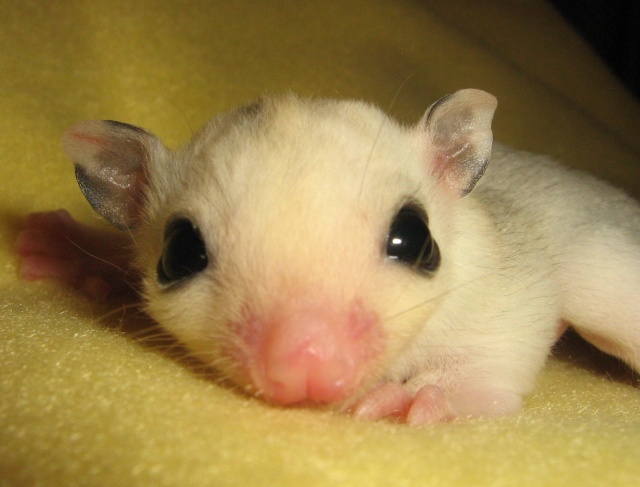
Have you ever wondered about the history and blood line of the gliders in North America? Seems to me we have really messed up. When gliders first started coming into the US they were mostly all from Australia. Then the majority of the imports started to come from New Guinea. Now they have been mixed and crossbred to the point that we do not have any idea where the captive gliders in America are from.
Most of the studies on wild gliders have been done in Australia on gliders from that country. I wonder how these studies would compare to similar studies that could be done in New Guinea. Or even the different regions in Australia. Would there be a difference in life expectancy between sugar gliders from the Islands and the Continent? What would be the differences in the diets and have they been separated long enough to have different dietary needs?
And now with the cross breeding between the gliders from the different areas and the breeding for colors here in the US we don't really know what we have. In the past it has been mentioned at how messed up the dog species have become but I think we are doing even worse with the gliders. Are we heading in the direction of having a few so called registered gliders and the rest are going to be mongrels with no background history? It is obvious that even the colored gliders that have a better set of records only go back a few generations. If you give it some serious thought we really have a genetic mess on our hands. Charlie H
You know that is so true. I was just thinking about that the other day. The bloodpool of the gliders here in North America has certainly been a melange of sorts.
Yes, from what I understand, the diets of wild gliders do vary cross-geographically, sometimes even vastly, especially with regards to plant materials. I mentioned in an earlier post that colonies of gliders observed on the Island of Tasmania never fed on Acacia at all, which is a primary food source for wild gliders found in most of Australia.
My glider, Chante, is half wild (on her mother's side) and she appears to be very different form any female glider I've seen. For one thing, the fur on her tail looks comparatively thin in contrast to her wide heavy body and big bone frame... and this among other differences.
It's also the reason why I think it would be interesting and perhaps ideal for some of the major breeders here in North America to perhaps look into purchasing captive gliders from countries abroad, particularly those where wild gliders may have penetrated the genepool to greater degree (I understand my parents' native Philippines, which is just a skip and a hop away from Australia and Indonesia, also has a pet sugar glider market) so to keep the bloodpool as close to the wild ancestor as possible (if deviating from the wild ancestor is considered "a genetic mess", that is. I suppose it depends on how you look at it).
If this ongoing process of morphism into some other sugar glider continues we will over some time have a case similar to pet ferrets, where we humans have owned and bred them captively for so long, that they no longer resemble their original wild ancestor. The closest thing to a pet ferret in the wild are polecats.
Your Chante sounds just like my Badger! He's big and gorgeous..something about him makes him the cutest of all (I'm biased..lol) He just looks and acts so much different from the rest I have. (and have seen) hmmm
Glider Kids - Badger and Bonnie, Pepsi and Grace, Victoria.. ahem..I mean ummm..Victor! and Isabella <img src="/ubbthreads/images/graemlins/smile.gif" alt="" />
Re: What Have We Done To Sugar Gliders?
[Re: ]
#71777 12/08/0504:15 PM12/08/0504:15 PM
Sorry <img src="/ubbthreads/images/graemlins/offtopic.gif" alt="" /> </font><blockquote><font class="small">Quote:</font><hr /> The closest thing to a pet ferret in the wild are polecats.
<hr /></blockquote><font class="post"> Mikey, what about black-footed ferrets? I know they are endangered, but aren't they a closer match to the domestic ferret than polecats? <img src="/ubbthreads/images/graemlins/nixweiss.gif" alt="" />
Re: What Have We Done To Sugar Gliders?
[Re: ]
#71778 12/08/0505:43 PM12/08/0505:43 PM
Yes, from what I understand, the diets of wild gliders do vary cross-geographically, sometimes even vastly, especially with regards to plant materials. I mentioned in an earlier post that colonies of gliders observed on the Island of Tasmania never fed on Acacia at all, which is a primary food source for wild gliders found in most of Australia. Mikey <img src="/ubbthreads/images/graemlins/dance.gif" alt="" />
<hr /></blockquote><font class="post">
Hi I am from Australia and would like to mention that Tasmania is part of Australia and the sugar gliders there do eat Acacia. It maybe possible it's a different species of Acacia as different regions do grow local varieties as they do in all plants but it is basically the same diet with local variations.
The Australian Sugar Gliders do look different to most of the gliders in the US and I am guessing that is that most of the gliders in the US are from Indonesian and/or New Guinea stock which are a different subspecies to ours. Also depending on how many gliders were actually introduced into America originally would probably account for certain features and colouring becoming more apparant and maybe possible interbreeding to stamp a type.
Recently in this forum there was an thread posted about an article that appeared in an Australian paper on Pocket Pet Gliders in the USA.
All the forum comments were that the glider that appeared with this article was definitely not a sugar glider but a squirrel glider etc. I also have received emails telling me my avatar isn't a sugar glider but a squirrel glider but I can assure you my 5 Sugar Gliders are sugar gliders and so was that glider in that article! From this, I think there must be very obvious differences between the Australian Sugar Gliders and those in the US if I get so many comments about it.
I would also like to add, that all the gliders I have seen here in Australia have been much of the same colouring too ..without too much variation but then two of my gliders have the coveted white tips but this seems quite common here and not a preface to colour breeding.
Just an opinion from a different source which I thought you might finding interesting.
Cheers Marz
Re: What Have We Done To Sugar Gliders?
[Re: ]
#71779 12/08/0506:17 PM12/08/0506:17 PM
[:"green"]Marz, you bring up some interesting points that definitely help to clear up some of the confusion here in North America about sugar gliders in Australia.
Also, according to Chris (Ushuaia)'s weight study that he conducted a few years ago, there are three subspecies native to Australia. One of those, P.b. breviceps was introduced to Tasmania and "quickly multiplied and stabilized." </font><blockquote><font class="small">Quote:</font><hr /> ...two of my gliders have the coveted white tips but this seems quite common here and not a preface to colour breeding.
<hr /></blockquote><font class="post"> [:"green"]This statement is also borne out in Chris' study where he points out that "P.b. ariel can be easily identified by its white tipped tail."
Charlie, I agree that there was an unfortunate trend when gliders were first introduced to North America to not track their genetics. Unfortunately, there's not much we can do about the past. However, we can (& should) keep accurate records about what little geneology we do know at this point.
Well I think we as humans have a responsibility to try to keep the blood lines pure and the health of the gliders should be more of a critical issue. We are seeing increased numbers of mutilators and defects. Yes we have messed with nature and the ones paying are the gliders.
</font><blockquote><font class="small">Quote:</font><hr /> Hi I am from Australia and would like to mention that Tasmania is part of Australia and the sugar gliders there do eat Acacia. It maybe possible it's a different species of Acacia as different regions do grow local varieties as they do in all plants but it is basically the same diet with local variations.
<hr /></blockquote><font class="post">
Yes, Marz no doubt they have Acacia in Tasmania, Australia, but from a text reference I was given by Pockets (a member of GC, who owns a library kingdom of literature on the marsupials) there was a study done where the gliders were observed to completely neglect the Acacia species that grew in the region within study, and this was an observation made in Tasmania. I'll see if I can get the study for you, Marz. Whether this ommission of Acacia in the wild glider diets under study applies to the entire Island of Tasmania is irrelevant of the initial point I was trying to make in response to what Charlie stated, which was that the wild glider diets do vary cross-geographically, more than one may think. There are other references that were also given to me where the dietary botanical components were vastly different, again depending on the region.
Also, regarding the immigration of the original ancestors here in North America, Pockets also was helpful in mentioning that our gliders are likely a mix of gliders from all over Oceana, and not mainly Indonesia/New Guinea as is commonly believed. I hope she publishes that book soon!
Well, hmph..my Glider kids are American. I'm American. I'm a heinz 57 mixed up DNA in a strange Gene pool of Lord knows who or what. Good to know my kids are actually related to me after all! They ended up in the right country..the melting pot! hehe okay..so I need sleep <img src="/ubbthreads/images/graemlins/smile.gif" alt="" />
Glider Kids - Badger and Bonnie, Pepsi and Grace, Victoria.. ahem..I mean ummm..Victor! and Isabella <img src="/ubbthreads/images/graemlins/smile.gif" alt="" />
Re: What Have We Done To Sugar Gliders?
[Re: ]
#71783 12/09/0502:52 PM12/09/0502:52 PM
The glider community as a whole gives a lot of attention to the color variations of gliders. Something that puzzles me is the facial features. Some gliders have short snouts and rounded faces. Others have longer snouts and faces that much resemble a rat. Someone once said that the gliders with the longer snouts were from Indonesia. <img src="/ubbthreads/images/graemlins/nixweiss.gif" alt="" /> Whether true or not without any paper trail we now have come up with a mixture of gliders and have no idea about their origin. Another thing that puzzles me is that gliders seem to come in various sizes. I would think that all gliders of a certain gene pool would be approximately the same size. But with the mixing of gliders from different geographical areas they now seem to come in a wide range of sizes. I'm not talking about pygmy gliders or squirrel gliders but the gliders we all have as pets vary in size. Charlie H
I've wondered about that too Charlie. Badger has a short snout, rounded face and is HUGE compared to our other 3. Bonnie (his wife) is a white face with also a round face. Pepsi has a loooong snout and his tail curls all the way around and loops again. (never saw that before) He is also built very different from Badger. Grace also has a longer snout and is tiny in stature. Four gliders, none of mine look alike or are built alike. Most animals in the same gene pool at least pretty much look the same aside from color.
Glider Kids - Badger and Bonnie, Pepsi and Grace, Victoria.. ahem..I mean ummm..Victor! and Isabella <img src="/ubbthreads/images/graemlins/smile.gif" alt="" />
Re: What Have We Done To Sugar Gliders?
[Re: ]
#71786 12/09/0504:24 PM12/09/0504:24 PM
Here's something else to think about. How large was the original genepool, from which the thousands of gliders born yearly in this country are derived? Gliders can not and have not been able to be imported to improve genetics for several years now. How many of the issues we are seeing may simply be due to not a big enough gene pool to start with, and what may in some form be almost inbreeding at this point? Then to breed that extraordinarily limited genepool even smaller for color variations...Is it any wonder we're having issues? I really don't mind being shot..but I do think breeding has gone way out of control at this point..especially considering the thousands of mill and brokered gliders that are sold each year (so you bought two from a mall, pet store, or show of some kind...at different times...who all get their gliders from the same sources, normally, what is to prevent them from being related? The "breeder" has no way to tell...then those gliders are bred and put into the gene pool...) And even those from reputable breeders-where did their first gliders come from, and what was their background and ancestry?? (And I am NOT saying it isn't MUCH better to buy from a reputable breeder--it IS, and we have several on this board whom I have great respect for.) I am saying we have a much bigger issue than most will either realize or admit to, diets aside, and regardless of where they originated.
Just a few thoughts to throw into the mix, here.
Last edited by Xfilefan; 12/09/0504:27 PM.
Jen/Colin Commander Riker 12 16 02-10 04 12 you will be FOREVER missed Sinbad, Gabby, Baby, and Alley
Re: What Have We Done To Sugar Gliders?
[Re: ]
#71787 12/09/0504:39 PM12/09/0504:39 PM
</font><blockquote><font class="small">Quote:</font><hr /> It's also the reason why I think it would be interesting and perhaps ideal for some of the major breeders here in North America to perhaps look into purchasing captive gliders from countries abroad...
<hr /></blockquote><font class="post">
So how about it breeders? What measures would that entail? How much money would that cost, and are people willing to pay that for the sake of diversifying the bloodpool for our little ones and our little ones to come?
I must say it's great to see people thinking critically about our gliders' future time.
Mikey, does Chante look different than the "normal" looking ones we all see here? Sorry if that's worded wrong..you know what I mean! LOL I was just wondering because of the debate about ours looking different than the ones in Australia. <img src="/ubbthreads/images/graemlins/smile.gif" alt="" />
Glider Kids - Badger and Bonnie, Pepsi and Grace, Victoria.. ahem..I mean ummm..Victor! and Isabella <img src="/ubbthreads/images/graemlins/smile.gif" alt="" />
Re: What Have We Done To Sugar Gliders?
[Re: ]
#71789 12/09/0505:58 PM12/09/0505:58 PM
</font><blockquote><font class="small">Quote:</font><hr /> The glider community as a whole gives a lot of attention to the color variations of gliders. Something that puzzles me is the facial features. Some gliders have short snouts and rounded faces. Others have longer snouts and faces that much resemble a rat. Someone once said that the gliders with the longer snouts were from Indonesia. <img src="/ubbthreads/images/graemlins/nixweiss.gif" alt="" /> Whether true or not without any paper trail we now have come up with a mixture of gliders and have no idea about their origin. Another thing that puzzles me is that gliders seem to come in various sizes. I would think that all gliders of a certain gene pool would be approximately the same size. But with the mixing of gliders from different geographical areas they now seem to come in a wide range of sizes. I'm not talking about pygmy gliders or squirrel gliders but the gliders we all have as pets vary in size. Charlie H
<hr /></blockquote><font class="post">
Hi Charlie. When viewing the photos of the gliders on these forums, many are distinctly different to what I am used to seeing here in Australia. On the whole here (in Australia), gliders have rounder faces, their ears are also rounder and less pointed.
I was wondering if anyone had photos of native Indonesian sugar gliders for a comparison? I had a quick look on google but I came up with only Australian and American sites with only references to Indonesia and no photos. It would be interesting to see what they look like and maybe that is where the longer snout originates from as you have heard.
Cheers Marz
Last edited by Marz; 12/09/0506:01 PM.
Re: What Have We Done To Sugar Gliders?
[Re: ]
#71790 12/09/0506:13 PM12/09/0506:13 PM
Here is a pic of Badger...my "different one" <img src="/ubbthreads/images/graemlins/smile.gif" alt="" /> I'll get better ones later ..they are all over my puter and I need to put them in one folder..grrr
Glider Kids - Badger and Bonnie, Pepsi and Grace, Victoria.. ahem..I mean ummm..Victor! and Isabella <img src="/ubbthreads/images/graemlins/smile.gif" alt="" />
Re: What Have We Done To Sugar Gliders?
[Re: ]
#71791 12/09/0506:15 PM12/09/0506:15 PM
The other one...on my shoulder. He has cute round ears, head and body...lol He weighs app. 226 grams. (glides, runs..everything) not obese for his size.
Glider Kids - Badger and Bonnie, Pepsi and Grace, Victoria.. ahem..I mean ummm..Victor! and Isabella <img src="/ubbthreads/images/graemlins/smile.gif" alt="" />
Re: What Have We Done To Sugar Gliders?
[Re: ]
#71792 12/09/0506:45 PM12/09/0506:45 PM
Yes, Chante does look kinda different. Her face is pudgier, and she's plump, and I don't mean fat plump, but it's lean mass. I'm going to try to get a pic of her, but she's currently sleeping under my shirt. Hopefully she won't mind a quick photoshoot! <img src="/ubbthreads/images/graemlins/smile.gif" alt="" />
Her colours are interesting, too. In the light she's got reddish, orange hues.
Here she is, alittle groggy, though. It doesn't really show as well in the feeble photos but there are differences in her profile that I see, that I'm assuming may be from her wild side. She's also big boned. She was bigger-boned than Dante (who was completely of captive glider blood). I've also noticed that she has a rather thick neck, and perhaps that's what may be making her face look pudgier. Behaviourally, though, I'm not sure if her apprehensiveness, strong will, and overall stealth comes from her wild genes or simply elements of her personality.
<img src="/ubbthreads/images/graemlins/offtopic.gif" alt="" /> She's currently in the army pattern SGGA 2005 pouch that was given with the Cal/vit supps in the raffle. She loves the blanket that came in the goodie bag and also the greenish blanket that came with the coconut swing made by Peggy.
Wow, she does have a big ole neck! She's purdy though... She is built quite similar to my Zephyyr, who is massive despite his size but isn't fat or unhealthy looking, he is as active as the rest of my gliders but he is bigger than any of the other 6.... Ima try and get some newer pics of him (and the others too)... Interesting...
Amanda, Jeff&
A Pomchi named Wickett A Yorkie named Meeya A Great Dane named Berlyn 5 Cats Kamorah, Aiko, Mo, Peekaboo, & Alice Someday Ill have more suggies... 2 skin kids - Xander Finlay James March6 2010, and Rohan Kingsley July 5 2011
Re: What Have We Done To Sugar Gliders?
[Re: ]
#71795 12/09/0508:27 PM12/09/0508:27 PM
In a small gene pool such as the one for the American glider there are two things that can happen... 1) deleterious alleles can be purged and result in a genetically similar, but healthy, population (similar to what has happened with the cheetas in Africa) 2) there may be enough possibly deleterious genes that the gliders will not be able to survive the purge (as almost happened to the prarie(sp) chicken in Illinois)
Charlie mentioned the breeding of dogs and some of the horrors that are now commonly associated with pure breds (hip dysplasia is almost all breeds, bladder stones in bishon fries, heart problems in many) due to the massive inbreeding... but he did not talk a/b some of the problems that have arisen due to what was bred for... a deep chest like that of the borzoi can lead to a condition similar to cholic(turing of GI tract), the face folds and nasal structure of bull dogs often makes them snort and have some trouble breeding... my question, is it possible that breeding for some of the colors could not also be tied to a physical characteristic that might, one day, lead to hitherto unknown problems.
case in point, it is my understanding that many mosaic/white patterened gliders are sterile... has anyone considered why? what would cause sterility to be linked to a certain coat color?
I could go on forever, but I think I've said what I wanted. A simple way to look at what has been done to the captive glider would be to look at DNA from wild species (across their natural distribution) and compare it to a cross section of the US's captive ones... perhaps there aren't as much genetic diversity in the wild popultaion as we would assume (though there probably is a lot condidering the variation in color and size and structure we have so far been able to breed out of these guys)
ahhh... man's interaction with his environment, beautiful... isn't it?
Re: What Have We Done To Sugar Gliders?
[Re: ]
#71796 12/09/0508:50 PM12/09/0508:50 PM
</font><blockquote><font class="small">Quote:</font><hr /> In a small gene pool such as the one for the American glider there are two things that can happen... 1) deleterious alleles can be purged and result in a genetically similar, but healthy, population (similar to what has happened with the cheetas in Africa)
<hr /></blockquote><font class="post">
Yes, I was waiting for someone to bring up the example of African cheetahs! Excellent, Faery!
I don't think it's that immediate of a problem as whole just yet. I feel it's more of a concern right now for the exotic colour phenotypes. Actually what is being observed with our captive North American gliders is a perfectly natural process; evolution is happening on a small scale right now. It's a process called microevolution, and we are inadvertently creating a new animal by establishing a population within a restricted region (namely the North American pet trade) from a genepool, that though limited, is still capable of establishing completely, healthy animals. It's not necessarily a bad thing, and it depends really on how you look at it (as is seen in some of the more optimistic posts of this thread). Health complications, physiological morphs, phenotypic deletion, and such happens even in the wild where a populace is forced to propogate within a restricted region. We're playing God and we don't even know it (which entails we are witnesses to the "not so pretty side" of things)... or perhaps we're more analagous to a sudden geographical boundary like the breaking off of a land mass or the erection of a mountain or something!
I love the idea of the American pet trade being a mountain... very poetic!
I only pointed out the bad because it's what's of concern and what comes to mind... without knowing exactly how the color genes work, we don't know what could be linked to the colors, or what may have cropped up in one of those lines... and I do agree that the color lines are of the most concern with this
In the American quarter horse there was a stud named _____ (my roomate would kill me if she knew I couldn't remember his name!) he had a genetic defect, but was a great horse and a champion etc... and was bred all over... this genetic disease is soo harmful that the AQHA has/is seriously not allowing any horse from his blood lines to register quarter horse in the hopes of getting the allele out of the population... a good example of what can happen when a line is based off of an individual...
hopefully there's no chance of this kind of disaster happening to our little ones...
It's too bad we can't go back in time and see just how many individuals originating from where set up the population we have now... so unless someone with access to cells and a DNA lab is willing to run the gels and assays to figure out how deep the gene pool is, we'll just have to wait and hope.
amazing how much power humans really have... to be able to produce animals that are virtually unrecognizable to the original stock (think of a pomerainian and a wolf or the domestic cow vs its ancestors)
apparently I hadn't said everything I wanted to, topics of evolution/genetics makes me long winded, I apologize.
Re: What Have We Done To Sugar Gliders?
[Re: ]
#71798 12/09/0510:18 PM12/09/0510:18 PM
Faery the horses name was IMPRESSIVE, (he was half Thoroughbred so he was an appendix QH rather than a purebred)and the disease is called HYPP (Hyperkalemic Periodic Paralysis)
There has been much line breeding within his lines and unfortunately has created quite an isssue with AQHA and APHA (QH and Paint Horse registries) And you are correct they are very strict now with testing of these horses to ensure they do not carry the allele/gene that carries this defect. Any carriers are being asked not to be bred and if they are may be denied registry by these associations.
What happens is these horses mature much to quickly being that the lines are used mainly for 'Halter' events in which horses are shown most extensively in their yealing year and are fed a diet high in grains, proteins etc to bulk up their size, furthur making it difficult for the yealing to be able to grow peoperly, their joints and bones just cannot support the mass they put on during their youngest and most developmental years... here is an explanation taken from one of my ccollege books:
Genes carry coded messages to the protein-making apparatus in the body - these proteins become things that are as diverse as muscles, hooves, and microscopic channels in muscle cells. Mutations tend to occur spontaneously in certain individuals - indeed, we all likely will have mutations in our genetic code at some point, but, generally, no outward effect is seen. Occasionally, as with the Impressive mutation, the consequences are enormous. As far as we know, HYPP is only seen in horses that have inherited the gene for the disease Impressive's bloodline. That is why we generally see the disease in Quarterhorses and horses that have Quarterhorse blood, such as Apaloosas, Paints, and Palominos. As fate would have it, not only did Impressive have a genetic mutation for his muscle sodium channel, but he also had an outwardly very desirable trait - his musculature - that resulted in him being a leading sire, thus, by the early 90s, over 50,000 Quarterhorses had Impressive inheritance. So, Impressive's physique was, in a way, a Trojan horse that allowed a huge and consequential flaw to be transmitted to a large number of horses.
HYPP in the horse is a dominant trait. Remember that we all receive two copies of most genes - one from our mothers and one from our fathers. With a dominant trait, the mutation only has to be present on one copy of the gene in order for the trait - in this case the disease, HYPP - to be seen. With recessive genes, on the other hand, both genes must have the mutation for the disease to be seen. What are the practical consequences of this? If an HYPP positive horse is bred to an HYPP negative horse, at least 50% of their offspring will have HYPP, and up to 100% of their offspring will have HYPP, depending if the positive horse has inherited the trait from both parents (homozygous) or only from one (heterozygous). It also seems that homozygous horses are more severely affected than heterozygous horses - it may be that with two copies of the abnormal gene, more of the muscle cells are affected.
Anyhow, I hope this explains the IMPRESSIVE problem (hardy har har) in horses... i don't know too much about genetics and stuff in other aniamsl but I keep up on my horse stuff.. <img src="/ubbthreads/images/graemlins/nixweiss.gif" alt="" /> Anyways sorry to go off topic there but as a horse person i felt the need to... <img src="/ubbthreads/images/graemlins/smirk.gif" alt="" />
A
Attached is a photo of IMPRESSIVE...
Amanda, Jeff&
A Pomchi named Wickett A Yorkie named Meeya A Great Dane named Berlyn 5 Cats Kamorah, Aiko, Mo, Peekaboo, & Alice Someday Ill have more suggies... 2 skin kids - Xander Finlay James March6 2010, and Rohan Kingsley July 5 2011
Re: What Have We Done To Sugar Gliders?
[Re: ]
#71799 12/09/0510:23 PM12/09/0510:23 PM
Melanie, you hit on something that really struck our interest. Since we deal with multiple rescues we have noticed that some of the male/female pairs we have do not breed. No need for neutering! These gliders are from white face blood lines and are well within the age range for reproducing but never mate or reproduce. We have two females and four males that show no intrest in mateing. Of course we have had others that are just the opposite and seem to be overly sexually active. The ones that do not reproduce makes me wonder who else has gliders that are like this. Have we already started a trend? Charlie H
I have mixed feelings about a possible trend in sterile animals... if it is true, is it such a bad thing if it does not entail any other problems for the glider? It would help keep the glider population down which could possibly lead to less rescues for people like yourself, Charlie, to take in and try to rehome.
People have tried, and probably are still trying, to reduce pest/invasive species by sterilizing the population and or introducing sterile males. I'm not saying that gliders are either, but they are falling into a category where more and more people seem to be acquring gliders with no real idea how to take care of them (I was just talking to my vet about the trend she's seen in the number and health of the gliders that come in). This trend worries me because there is no "easy way out" when taking care of gliders. So would having a genetically sterile sect of the population be soo bad?
On the other hand, how do you try to control the "sterility"? First we would need a way pinpoint what was causing it, what kind of mutation, and at the same time, where did it start? Why is it in the white lines? Does it crop up in any of the other lines? Is it possibly something from the natural evolution of the animal? (meaning whites are not likely to survive in the wild due to predation, could there also be a genetic problem linked to that particular coat color?)
interesting... anyone have any other ideas/insights?
Re: What Have We Done To Sugar Gliders?
[Re: ]
#71802 12/11/0509:51 AM12/11/0509:51 AM
Melanie, on the thought of producing sterile gliders, maybe we have somehow managed to come up with a genetic mis-match. For instance a male donkey can breed a mare and produce a mule. Mules do not reproduce. Maybe there is more differences in the sub species of gliders than we realize. Charlie H
Charlie, I was just getting ready to post just about the same thing as you this morning.
Watched a program last night and they were talking about the Horse and Donkey producing a mule, and them being sterile. Also talked about a Tiger and Lion producing a Liger, however they are HUGE HUGE cats, they are also sterile. Does make one wonder about the subspecies.
About the Impressive bloodlines, and a bit <img src="/ubbthreads/images/graemlins/offtopic.gif" alt="" /> here, but he also passed on (through maaaany generations, since he was incredibly prepotent) a NASTY attitude. If you've got a mean, biting, kicking, ear-pinning, over-all [censored] halterhorse, you can be 90% sure it's got Impressive a couple generations back. :-p
Anybody notice certain attitudes prevaling in the glider world, especially in certain bloodlines (such as the specific color lines)?
Re: What Have We Done To Sugar Gliders?
[Re: ]
#71805 12/11/0501:55 PM12/11/0501:55 PM
</font><blockquote><font class="small">Quote:</font><hr /> Maybe there is more differences in the sub species of gliders than we realize.
<hr /></blockquote><font class="post">
...or we're begining to create new species within the captive population. I'm telling you it's evolution happening here and we're witnessing nature take its course. <img src="/ubbthreads/images/graemlins/smile.gif" alt="" /> Exciting stuff!
Alot of the ear pinning nasty, biting, kicking halter horse stuff doesn't necessarily come from IMPRESSIVE genetics... It comes frome BEING a halter horse. These guys are, in my opinion prevented from 'being' horses, the majorioty of these animals are ' worth too much money' to be allowed to run around in a wide open field like they should be allowed to. They are instead kept in a nice stall, in a closed up barn to prevent injury and therefore 'blemishes' or scars which takes away from their appeal to a judge in the show ring. To further the problem they are fed a high energy diet which creates issues with pent up energy.. this pent up energy emerges as nastiness simply because there isnt anywhere else for it to go. If you walk thru the show pen at a show you will see these animals with some of the most irritating habits in their stalls, weaving, many of them are cribbers, pawing, grazing their teeth on the doors and walls of their pens, etc.
What the judges want to see and what excites a crowd in the show ring is a horse that enters the ring and turns heads - a horse that eneters reared up on two legs does just that, and it has become a desireable thing for a halter horse to do this.. Why do you think stud colts and stallions are shown most frequently in the halter circuit rather than mares and geldings?? Because they are high strung to begin with, with all that testosterone runnin thru them and being cooped up in a stall 24/7 doesn't help.. thus these horses appear to be pig headed, biting, kicking, ear pinning disasters but the poor guys just wanna have some freedom just like any other horse... Also they do not, if you watch them understand how to communicate with another horse, they will either be too afraid of the sight of another free standing horse beside them and shake and cower or else they will go NUTS! Biting kicking etc because they just dont know what else to do.. <img src="/ubbthreads/images/graemlins/shakehead.gif" alt="" />
I think Mikey himself has made a bit of an observation (correct me if I am wrong Mikey) That Chante has been a bit harder to bond with, she is generally just more aloof with him than his Dante was. Maybe this is her wild instincts coming out and maybe not, its a little hard to tell without other wild caught or recently wild caught blood in the genetics... <img src="/ubbthreads/images/graemlins/nixweiss.gif" alt="" /> And every glider is different... I just know that with Halter Horses the nastiness isnt necessarily because of their lines.... They are meant to 'IMPRESS" the judges with their strength and believe it or not the wild eyes they get are a turn on for most judges as well..... But just like gliders every horse is different and I think manhy of the bad habits ANY horse gets has alot to do with the past experiences.. but thats another story altogether..
A <img src="/ubbthreads/images/graemlins/wave.gif" alt="" />
Amanda, Jeff&
A Pomchi named Wickett A Yorkie named Meeya A Great Dane named Berlyn 5 Cats Kamorah, Aiko, Mo, Peekaboo, & Alice Someday Ill have more suggies... 2 skin kids - Xander Finlay James March6 2010, and Rohan Kingsley July 5 2011
Re: What Have We Done To Sugar Gliders?
[Re: ]
#71807 12/11/0503:45 PM12/11/0503:45 PM
</font><blockquote><font class="small">Quote:</font><hr /> I think Mikey himself has made a bit of an observation (correct me if I am wrong Mikey) That Chante has been a bit harder to bond with, she is generally just more aloof with him than his Dante was. Maybe this is her wild instincts coming out and maybe not, its a little hard to tell without other wild caught or recently wild caught blood in the genetics...
<hr /></blockquote><font class="post">
Yeah, you're right. bonding is taking a tad bit longer, but I've got all the patience in the world. She certainly is aloof, and is strict with her rules. She was like that with Dante, too! However, yesterday Chante slept in my palm in her pouch for the first time, as long as I kept stroking her (I think she likes to be groomed) with my finger. Her bites whenever she does bite have reduced to little teeth pinches. We're moving along slowly... We'll get there... <img src="/ubbthreads/images/graemlins/smile.gif" alt="" />
Im glad Mikey <img src="/ubbthreads/images/graemlins/grin.gif" alt="" /> sounds to me like u r winning her over, my most bonded pair (Pocket and Keyo) Still gimme lil teeth pinches, I thinks it their grooming me back.. Which is not so nice when i've got'em in my top in public.. <img src="/ubbthreads/images/graemlins/crazy.gif" alt="" /> <img src="/ubbthreads/images/graemlins/roflmao.gif" alt="" /> <img src="/ubbthreads/images/graemlins/offtopic.gif" alt="" />
U said she likes to be sung to try that as well... <img src="/ubbthreads/images/graemlins/heartpump.gif" alt="" />
A Pomchi named Wickett A Yorkie named Meeya A Great Dane named Berlyn 5 Cats Kamorah, Aiko, Mo, Peekaboo, & Alice Someday Ill have more suggies... 2 skin kids - Xander Finlay James March6 2010, and Rohan Kingsley July 5 2011
Re: What Have We Done To Sugar Gliders?
[Re: ]
#71809 12/11/0505:22 PM12/11/0505:22 PM
I don't disagree that it is possible that there are subspecies involved which may be attributing to the sterlity... but I find it hard to believe evolution could be moving soo quickly... I mean, gliders have only been in the states for a short while (geologically speaking) and evolution is usually on the geological scale...
unless there's a possibility that by having most of our gliders from one country/area we started out with animals that were already on their way to specization...
as for creating sterile hybrids (such as mules and ligers) there I think it is a possible explanation, but I would think that the sterility would be more prevalent. Meaning it would most likely affect more animals than it appears to (I don't have numbers so I'm generalizing) unless of course the white lines have somehow come out in 2 subspecies (though if they're only producing non-viable offspring they'd be upgraded to 2 species)
<img src="/ubbthreads/images/graemlins/offtopic.gif" alt="" /> on the Impressive bloodlines and personalities... my roomate has a QH with Impressive blood and he's a pistol to say the least... he does western and english pleasure, not halter (though he's huge for what he does) so he gets out and plays... so it may also be a genetic thing that's aggrevated by the environment that the animals are kept in
Re: What Have We Done To Sugar Gliders?
[Re: ]
#71810 12/11/0505:52 PM12/11/0505:52 PM
It is true, we do lack a good knowledge of the true background of the gliders that we do have. I'm not clear on what the problems are, aside from sterility (which pretty much only affects certain color lines sparingly), that we are seeing because of this?
Re: What Have We Done To Sugar Gliders?
[Re: ]
#71811 12/11/0506:12 PM12/11/0506:12 PM
Like I said.... It isnt necessarily bloodlines but sure some horses are pistols and some arent Ive known lots of impressive bred horses who are dead quiet..It also has alot to do with the Dams lines as well...I find the horses that compete are also miore likely to be exciteable..LOL Obviosuly...Not really that different from humans..LOL
Amanda, Jeff&
A Pomchi named Wickett A Yorkie named Meeya A Great Dane named Berlyn 5 Cats Kamorah, Aiko, Mo, Peekaboo, & Alice Someday Ill have more suggies... 2 skin kids - Xander Finlay James March6 2010, and Rohan Kingsley July 5 2011
Re: What Have We Done To Sugar Gliders?
[Re: ]
#71812 12/11/0506:20 PM12/11/0506:20 PM
Just curious, but how do we know for sure they are ALL sterile?
Glider Kids - Badger and Bonnie, Pepsi and Grace, Victoria.. ahem..I mean ummm..Victor! and Isabella <img src="/ubbthreads/images/graemlins/smile.gif" alt="" />
Re: What Have We Done To Sugar Gliders?
[Re: ]
#71813 12/11/0506:29 PM12/11/0506:29 PM
Ern, I think other complications referred to increased health-related issues and a decreasing body mass (in comparison to the original wild ancestor) due to limited genepool, as well.
Again <img src="/ubbthreads/images/graemlins/offtopic.gif" alt="" /> but I've known multiple Impressive-bred horses, and my trainer has too, that just had a schizophrenic-like personality problem. They are in general quick learners (in my experience) because they are generally very smart. But they have an attitude that makes them strike out at you for apparently no reason and with no provocation. I'm speaking of a Paint I had that was half thoroughbred (which also made her hot) and Impressive bred on her Paint (dam's) side. I'm also speaking of an Appy mare that also had these weird aggressive episodes. They were halterbred (Impressive-bred) a couple generations back, but after that they were pleasure bred for English and Western. I have no doubt that Impressive consistently stamps his get, grand get, and great-grand get with an unpredictable bad attitude, regardless of training or past experiences.
Then again, there are good horses in every pedigree, and maybe some of his brood didn't inherit the personality. But I'd personally look long and hard before ever buying an Impressive horse, even if Impressive only showed up once in the last 4 generations, even if the horse was HYPP negative.
To be on topic a bit, I think that it's quite possible that certain personality traits could be stamped through glider generations as well, other than just what the parent gliders are teaching their joeys. Genetically, I think it's quite possible to breed is more docile or more excitable gliders either specifically looking for those traits, or even accidentally as in the case with Impressive. Yes, that glider is gorgeous, but do you really like to handle it? If not, it probably shouldn't be bred.
(And again, this is all genetically speaking, and if you DON'T handle the gliders, they obviously will be less friendly. But I'm speaking of a glider that bites (not love or marking bites) it's whole life, but it was raised by the breeder and it for sure hasn't been abused. I haven't KNOWN a glider like that, but I'm thinking it could happen.
Thoughts?
Re: What Have We Done To Sugar Gliders?
[Re: ]
#71815 12/11/0508:34 PM12/11/0508:34 PM
<img src="/ubbthreads/images/graemlins/offtopic.gif" alt="" />Keyosmama, you know your stuff! Everytime I see something I wanted to reply to you beat me to it. I have an Impressive bred horse, an great-granddaughter to be exact, and she is the most laid back, sweetheart of a horse that you could find and so are her sire, siblings and offspring. She is also HYPP neg/neg or it would be irresponsible to breed her. Something that I don't think anyone mentioned here was one of the reasons that HYPP is a bad thing. These horses that are positive (either with the single or double gene) have a tendancy to drop dead with no apparant cause. I believe this is what brought the gene to light, after Impressive had impregnated hundreds if not thousands of mares. One thing I want to mention is that just because a horse is Impressive bred does not mean that it is going to have a nasty disposition. I will agree that I have met some nasty Impressive bred horses but as time goes on they seem to be getting less prevalent, maybe their "bad attitude" blood is being diluted enough. One more thing I wanted to touch on: </font><blockquote><font class="small">Quote:</font><hr /> this genetic disease is soo harmful that the AQHA has/is seriously not allowing any horse from his blood lines to register quarter horse in the hopes of getting the allele out of the population
<hr /></blockquote><font class="post"> This is just not true. As Keyosmama stated if a horse has the gene then it runs the risk of not being able to be registered, but just because it is Impressive bred does not mean that it carries the gene.
Ok, back to the regularly scheduled discussion. <img src="/ubbthreads/images/graemlins/roflmao.gif" alt="" />
Re: What Have We Done To Sugar Gliders?
[Re: ]
#71816 12/11/0510:52 PM12/11/0510:52 PM
</font><blockquote><font class="small">Quote:</font><hr /> Ern, I think other complications referred to increased health-related issues and a decreasing body mass (in comparison to the original wild ancestor) due to limited genepool, as well.
<hr /></blockquote><font class="post"> I see the concern, but I don't think that at this point that we could attribute those problems to the limited gene pool? I've had joeys born to smaller gliders that were raised on bad diets, these joeys when raised on a good diet regularly turned into much larger mature gliders than their parents. It seems to me that there aren't that many illnesses and diseases that affect captive gliders as a whole currently, and the majority of these illnesses seem to be attributed to improper diet and improper housing/care.
With the inbreeding of different gliders that are from different geographical regions, I see it as more of a man-made evolutionary branch. I don't feel that the cross breeding is necessarily good nor bad, it's really hard to say, I don't think that it ulimately will have been a bad move. At this point, there are so many variables in the equation. It's really hard to say what's the root cause of the problems that we do see in captive gliders. I do agree that in the future, record keeping will need to be done and genetic issues will need to be recorded and bred out of the lines. I don't think that we are headed towards causing the demise of the glider. Captive Chinchillas are all descended from a small handful of original chins and they gave rise to a huge and primarily healthy population of animals from a very limited gene pool. This is definitely the result of good record keeping, which, after many variables in glider keeping are removed will also begin to yield results and do good for the captive glider.
Re: What Have We Done To Sugar Gliders?
[Re: ]
#71817 12/12/0508:28 AM12/12/0508:28 AM
Ern, a lot of what you say is correct. The big problem I see with record keeping is going to be setting a base to start from. Gliders became so popular in such a short period of time and we have no idea about where they came from. It would be very difficult for a group to set a standard for gliders now. And with the breeders breeding for colors it only confuses the issue even more.
Since we have a couple of horse people I will mention how breeding for color can mess up a breed. The Appaloosa in the old days was a breed developed by the Nez Pierce in the Northwest. These horses had the attractive color with the spots that are so sought after. The present day only resembles the original Apps in that respect. The original horses were bred to be mountain horses and were very sure footed. And believe it or not they were what the old timers called mule footed. Their hooves were more narrow and long similar to a mule. Then the breeders got involved and started a registery and would sign up any horse with the spots on its rear. They introduced the quarer horse blood line into this group and now there are no 'real' Appaloosas left. About the only thing left in common with the original is the name and colors. Now they have a registery for the American Paint Horse which is based on color more than breed. What about the original Palamino? Breeding for color has really messed up the horse breeders and will eventually do the same to sugar gliders. The focus turns toward color and not preservation of a particular breed or bloodline. Color breeders, don't get the idea I am bashing you. <img src="/ubbthreads/images/graemlins/smile.gif" alt="" /> As a group you probably have the best records going for the captive glider. And maybe as a result of your collective work you have the best source for attempting to establish some sort of a breeding standard. But I am afraid the mega breeders have already and will continue to keep this from ever happening. Charlie H
It's been said that for a group to remain unimbred(Ahh I love the national geogrphic channel) that you need to start with 100 unrelated individuals, be they human or animal. If fifty pairs have offspring, and thier offspring have offspring, the colony can survive for many thousands of years. Its how they plan to eventualy do long term space travel. In dogs and horses, inbreeding was done to extract specific traits, its also being done with cats. You want a short dog with lots of energy with black fur and you have four related dogs all with those traits, you mix and match them and their offspring till you get what you desire and continue to breed those pairs that get you those desired traits to breed with their offspiring as well as the other litters and eventualy, we get out beloved pure-breeds. Its why many pure bred dogs have major health issues and lower life expectancies then a mutt. I see this moving more and more so tword the glider community...I saw a post about the mini-glider and it made me angry. Not to say it wasn't adorible and sweet, but do you really want another novilty among then novilty that they are already seen as? That mini glider may have terrible health problems. Dwarfism in many creatures is painful until it becomes a full-out genetic sequence without the conflicting genes that still tell it to grow. We've used it to make toys, and miniture horses and in that time, there were many horrible outcomes. I'm not saying that all selective trait breeding is a bad thing, and if done properly, it can aid in a more healthy creature, but its takes 100 different indiviuals, unrealted, of that trait to make sure that they are not so intwined that eventualy they begin to have health problems. Throwing a few unrealted plain greys into a color program wouldn't hurt.
Re: What Have We Done To Sugar Gliders?
[Re: ]
#71819 12/16/0502:48 PM12/16/0502:48 PM
Wow. I wonder where that number comes from, Captive? 100, I mean... Is that just a general number or an exact figure? Did National Geographic say that?
See, it's because I do know that different animals handle inbreeding differently, on a genetic level, that is. For instance, the inbreeding of most parasitic fauna like human hair lice or aphids or tapeworms only requires one gravid member to produce a whole colony of healthy individuals. Even animals like every single ant/bee/wasp/termite species for the most part mate with siblings over several generations (with reproductive members here and there mating with members of other colonies in the area, which to certain degree still promotes inbreeding) and produce hundreds of thousands of healthy offspring in their lifetime and have been doing so for millions of years in their existence.
Also, mice can handle (generally speaking, again) a certain amount of inbreeding moreso than humans can, for instance. The ability to handle inbreeding is a necessary asset to their very survival and continuation of their species. I believe the degree to which an organism can "handle" (I don't know what other word to use here) inbreeding may be affected by factors such as 1) the nature of the organism to live in large colonies and to populate an area of a high resources and 2) I'm guessing it's in the genes, too (i.e. the ability to handle inbreeding).
Interesting... It's amazing when you consider how physiologically different many animals often are from human beings. Many animals have evolved to supercede some of the most basic rules ( <img src="/ubbthreads/images/graemlins/offtopic.gif" alt="" /> Have you guys ever heard of the desert lizard species composed of entirely females, which "stimulate" each other to lay eggs, which hatch into more females? Let that sink in your brain a little! LOL. Also, female aphids will clone themselves, giving birth to exact genetic clones. In both cases aforementioned, the process of reproduction is called parthenogenesis).
Actually, having said that, as it relates to this thread, perhaps gliders can handle a little inbreeding better than we think. Out of curiosity now, are gliders considered pests in Australia? I'd imagine they are for Acacia farmers... Are they analagous to mice but for agricultural tree crops? <img src="/ubbthreads/images/graemlins/nixweiss.gif" alt="" />
Captivated...100? Well HELLO KIN!! LOL Guess that goes to show we all are really related! LMBO <img src="/ubbthreads/images/graemlins/smile.gif" alt="" />
Glider Kids - Badger and Bonnie, Pepsi and Grace, Victoria.. ahem..I mean ummm..Victor! and Isabella <img src="/ubbthreads/images/graemlins/smile.gif" alt="" />
Re: What Have We Done To Sugar Gliders?
[Re: ]
#71821 12/26/0501:35 PM12/26/0501:35 PM
Heheh. For humans its 100. Yes, I was watching a show about space travel, and in order to do long term space travel..i.e. Going to another possible planet that can support humans, they would ahve to put 100 people on the ship. A fifty fifty split. Now, it may or may not be different for gliders. But that should atleast give a ball park range... Eventualy, everyone is related in someway, you can't avoid it, and with our populations like they are, more then half of us may share a common relitive from way back when. For instance, my fiance, when you trace his liniage all the way back, is related to Gangus Kon. Now, between then and now, his genetic structure would probably have very little in common with Kon, and probably find it impossible to prove it. Imbreading also has a tendancy to cause genetic mutations.. So, it could very well be essential to have few inbred creatures to cause evolution, because, after all, we would all still be very close to our ape ancestors should those mutated genetics for a larger skull, no brow ridges and an upright posture not been passed down some how. Suddenly, those things became attractive to continue on the traits... Less body hair, ect. Infact, if it were possible, all of us could trace back our family trees to about 5 million primitive human beings...They really started the dispersment of human kind. Liek it or not, like dogs, most humans are based upon selective breeding throughout the years. Small feet in some cultures, thin waists in others, tall, short, blond, brunette. All areas had, once upon a time, a similair look to their people before mass migration began and we became the 'mutts' that we are. Now. I do know that soem fo the things i see happening with gliders aren't so much the genetics, but the politics kept. I have seen people avid about the good fo the glider gush over a genetic mutation and long for it while at the same moment voice their unhappiness about colored gliders being so suaght after. I am not accusing anyone here of that, but I have seen it many times throughout the internet and it disturbs me. I wont say I am innocent of doing this either..I want a bull terrier, and yet I dispise most dog breeding programs because they throw away those that aren't to the standards they had hoped.
Re: What Have We Done To Sugar Gliders?
[Re: ]
#71822 12/26/0501:37 PM12/26/0501:37 PM
Mikey asked if gliders were considered pests in Australia. I read one article that stated in a certain area the locals were complaining about gliders raiding their garbage cans. Much like rats in the states in some areas. <img src="/ubbthreads/images/graemlins/smile.gif" alt="" /> Charlie H
About 10 years ago, Jane, myself and a few others got into this discussion.. we looked at the gliders more like tribes.. bear with me on this ..
We looked at them as tribes, much like our American Indians, each tribe has their own set of Characteristics, demeanors, markings, lifestyles etc.. some also will not breed outside of the same tribe.
keeping this in mind, what Charlie is saying is correct, the same as the dogs, even those that are considered purebred. the "crossing of the ""breeds"" to create a specific Look also runs the risk of destroying other favorable characteristics. but also since different "tribes" have different demeanors, what will happen in the end to the metamophisis, or to the nasty demeanors that are coming out? will we end up creating our own set of "frankenstien gliders" or gliders that are so neurotic/psychotic that while we sleep they wake to rip their cages apart and eat us?
as insane and exaggerated as this sounds, it may not be too far down the line, where the cuteness is bred to become the watchdogs, that they are in the wild, for our homes.
Money being the root of all evil, has hit the glider community.. to breed for color isn't about anything but money. The faithful, gray that tore our hearts out, that got a hold of us and drug us into a new lifestyle will be as hard to find in 20 years, as the plats are today..
As for the sterility.. I say go for it, continue to create the monsters, make them all sterile, Breeding should not be a favorable charactistic anyway.. Then when they die off, we will be right where we all started 20 years ago.. gliderless.
I wouldn't trade my 2 grays, for 10 White Face blondes.. after all I have "originals" no morphing needed.. just add love..
agreed Bourbon. We have all greys..6 of them. They are happy, we are happy! They are truly the love and joy of my life..and I wouldn't trade them for anything <img src="/ubbthreads/images/graemlins/smile.gif" alt="" />
Glider Kids - Badger and Bonnie, Pepsi and Grace, Victoria.. ahem..I mean ummm..Victor! and Isabella <img src="/ubbthreads/images/graemlins/smile.gif" alt="" />
Re: What Have We Done To Sugar Gliders?
[Re: ]
#71826 01/11/0610:57 AM01/11/0610:57 AM
</font><blockquote><font class="small">Quote:</font><hr /> Money being the root of all evil, has hit the glider community.. to breed for color isn't about anything but money.
<hr /></blockquote><font class="post">
Money isn't what drives all breeders... I personally am offended by that statement, being that I own a large amount of color variation gliders. I breed for the joy of having a joey. May the joey be a WFB or a gray, I will still love it just the same...
</font><blockquote><font class="small">Quote:</font><hr /> As for the sterility.. I say go for it, continue to create the monsters, make them all sterile, Breeding should not be a favorable charactistic anyway..
<hr /></blockquote><font class="post">
I also don't think it's right to call sterile gliders monsters. They can't help what they are... Also, if breeding were such an unfavorable charactoristic, you wouldn't have any of your gliders either. It goes both ways.
Re: What Have We Done To Sugar Gliders?
[Re: ]
#71827 01/11/0602:22 PM01/11/0602:22 PM
</font><blockquote><font class="small">Quote:</font><hr /> Money being the root of all evil, has hit the glider community.. to breed for color isn't about anything but money.
<hr /></blockquote><font class="post">
I have to respectfully disagree with that statement! I only breed WFs; IMO there's more than enough grays in rescue, and although I do know it's coming, I have not seen a WF in rescue yet.
I do not breed for money. Anyone who knows me, knows that. I have two WF male joeys right now, that I've turned down at least 12 homes for. The home I chose, that I really adore and think is the best for them, I offered them to her for free. Unfortunately she turned me down (which just reinforced my opinion that she's the very best home, because she did NOT say, "ooh free and worth a lot of money, gimme"). I have plans to have the male in that trio neutered, but unfortunately buying a running car is going to have to come first. <img src="/ubbthreads/images/graemlins/smirk.gif" alt="" /> I'm getting another WF male sometime in the near future (as soon as he's paid for), and he will be neutered also. If everything goes well, I will have 5 WFs and two grays that are non-breeding, and only my 3rd gen pair left breeding. If I truly cared only for money, I'd have a lot more pairs, and the boys I have now would already be in a new home. I think the WFs are stunning, and mine have both beauty and absolutely wonderful personalities. I do not want to own (or breed for that matter) a mean glider of any color.
First of all, it is the LOVE of money that is the root of all evil, not money itself.
With that being said, I think the statement made about some breeders being in it just for the money is a very fair statement as SOME are. But this is not only for the color gliders but also for the standard greys as well. I know of several people that will breed and breed and breed and allow their greys to keep producing and keep selling the joeys no matter what the age or shape of the mother glider. I personally think that as a good respectable breeder, you should limit the amount you allow your glider to breed and produce and once they have hit that limit, do not just *discard them* and find them new homes because they are not *breeders* any longer. After all, they should be pets first.
If you pull up websites on gliders, there are many different ones out there, you have your mahogany gliders, your white tip gliders, your standard grey gliders, and so on....and these are in the wild....
I just think that putting everyone in the same category as being in it just for the money or the mutation is wrong, personally, and think everyone that does have joeys, whether as a hobby breeder or a full time breeder should take a look at themselves in the mirror and ask themselves, "Am I allowing this one to breed so I can make a quick 150 to 500 dollars to pay my bills, or because I love having a joey being born and once my girl has had a couple I will neuter her male and they will than remain with me forever as my beloved pets that I originally bought them for."
Working together, educating one another and helping one another learn and understand is the only way we are going to be able to help our gliders out.
I think that those are some harsh predictions for gliders of the future.
Demeanor is something that is partially related to genetics. The crossing of subspecies of gliders and the inbreeding of gliders will not certainly end with nasty gliders. The genes have to be there, then the inbreeding or crossbreeding will create nasty gliders. Responsible breeders should be taking note of the personalities of their gliders and they should NOT be breeding nasty gliders.
I think that a huge problem in the world of gliders and what will ultimately be a problem for gliders is overpopulation of gliders. Greys will never be scarce. Most people don't neuter their gliders or sell their gliders neutered and just let them breed at will.
I'm just not sure what the big problem is with what we've done to captive gliders by cross-breeding sub-species? It's not much different than an African mating with and Asian. We don't abhor that and call it wrong because they evolved in different areas. Sure, there is gonna be a genetic mix-up which could result in a genetically superior child, or there could be one with problems. When breeding any animals it's a gamble unless you pay attention to detail and are mindful of what you're pairing and why.
Re: What Have We Done To Sugar Gliders?
[Re: ]
#71830 01/11/0607:33 PM01/11/0607:33 PM
I must say I never thought I would see racial tension in the glider world ha-ha. It is never good to make such general statements as "to breed for color is just about the money", that is kind of harsh. I am waiting on two cinnamon males not for money but because I prefer the cinnamon color variation more than the grey. I have never had babies before and want to enjoy that aspect at some point (yes i know my males won't do it alone! I have my eyes open for a female ha-ha). When I am able to breed I will probably breed the cinnamon with another glider of similar color to have that color in my babies. It is not to breed for money but it is for the simple matter that I bought the type of glider I have the greatest preference for and yes, their babies will look the same, unless the milk mans glider sneaks in <img src="/ubbthreads/images/graemlins/tongue.gif" alt="" /> To your credit the grey glider is what brought me in to this world but now I expanded my knowledge of the species and a small preference developed. That is what makes me who I am and you who you are, preference <img src="/ubbthreads/images/graemlins/smile.gif" alt="" /> OH, I do love topics that spark emotion such as this, thanks for the post! No hard feelings here.
Re: What Have We Done To Sugar Gliders?
[Re: ]
#71831 01/11/0609:21 PM01/11/0609:21 PM
Yes Jeff, I thought that was a little harsh aswel - but at the same time, the avrage gal/guy isn't dealing with as many color variations as some of our large scale breeders. We might have a WFB here or a cinnimon there, but we're not dealing with over $1000 gliders.
Re: What Have We Done To Sugar Gliders?
[Re: ]
#71832 01/11/0609:34 PM01/11/0609:34 PM
Quoting mikey in the first page </font><blockquote><font class="small">Quote:</font><hr /> So how about it breeders? What measures would that entail? How much money would that cost, and are people willing to pay that for the sake of diversifying the bloodpool for our little ones and our little ones to come?
<hr /></blockquote><font class="post">
Mikey, first of all it would require a class C exhibitors license, as it's illegal to import for strictly "pet trade" you would also need a import license, we'd have to look into what the quarentine regulations where in the U.S. I would really like to get some australian sugar gliders. I would guess to be SAFE and make SURE you're getting what you put your money into, it would require a personal pick up and shipping arrangments. This would mean some one would have to go to australia, indonesia (or where ever else) to get them and bring them back. Now, I am applying for my class C USDA this spring, as some of you know - to do animal education with exotics. I think it would be very interesting to obtain some of these "wild type" gliders, not only to use for regulated breeding, but to study in general. They would be wonderful for education aswel. Now, at this point in time I wouldn't have the money to travel all over getting gliders back into the US. But withen the next three years once I get my savannah breeding program up and running and hopefully can sell some kittens to good homes, I might have enough funding to do something outragiouse like this. And by that time I will actually have my exhibitors license, will be doing educational tours and programs and will have proof that I'd be using the specimens for educational purposes.
-Kiki
Re: What Have We Done To Sugar Gliders?
[Re: ]
#71833 01/11/0610:17 PM01/11/0610:17 PM
Kikster, I think that is wonderful! <img src="/ubbthreads/images/graemlins/laugh.gif" alt="" /> My buddy, the arachnologist, has that license, too. It's how I get my hands on some of the most exotic bugs...
Kikster, I hope that really works out! <img src="/ubbthreads/images/graemlins/yelclap.gif" alt="" />
go back and read the whole post I never said all breeders WITH colors were in it for the money.. but I am seeing far more than many people out there are willing to speak out about. many of these "genetically altered" gliders are being born with nastier personalities, not just from a small breeder here and there but from large breeders of these colors..
I also didn't say that all sterile gliders were monsters..
the monster part came in with the personalities that are also being bred through these gliders trying to get colors. and I surely didn't say all white face gliders were mean..
Just like the breeders of yesterday and many of today, the money takes precendece over the sweetness of the gliders personalities again NOT ALL!!!
look at the mega breeders,, whether it is the grays or colors.. but this thread was about colors. and the genetic altering of the gliders for their colors, and the "POSSIBLE" ramifications of it..
think of the worst case scenerios... because that is all that we can do.. speculate, use supposition, and exaggerate.. we have NO CLUE what is going to happen to the gliders as long as we continue to genetically attempt to alter them..
A look at all breeds of animals can just about tell you where the gliders are heading.. not only best case scenerios, but also worse case..
nothing racial here.. but you have enough line breeding and inbreeding continue to go on, and you will have defective genes that will be passed on.
it is hard enough learning to deal with the everyday medical issues, and then you throw genetic altering in there and it opens a whole new set of doors that even the vets , labs and animal experts won't be able to figure out.
no reason to be offended by a general statement.. it wasn't directed at anyone in particular. after all "the sun is shining bright" is a general statement.. but in another part of the united states it could be raining..
i agree bourbon, i will only buy grey nothing like the original and better yet if i could get a wild caught id love it. i have the last of a dying breed my angel is unfortunatly too old to breed or i would since shes never been with a male. and is 6 yrs old. her parents were wild caught imports. from new guinea with the rounded face we no longer see and the large size. i call her my new guinea girl. today they are getting smaller and pointier faced. maybe someone should get some new imported stock somehow to get rid of the problems that are occurring as a result of inbreding and that was told to me from an aussie vet i e mail who has gliders living into their late teens. he said to me too bad you cant get some fresh bloodlines since they no longer export.
Re: What Have We Done To Sugar Gliders?
[Re: ]
#71836 01/12/0605:09 AM01/12/0605:09 AM
Genetic alteration is much different than selective breeding. Nothing is necessarily genetically altered when it comes to the glider variations that we see. Within all animals lies genetic variation. It's the key to the survival and adaptation of each species.
Genetic alteration involves direct manipulation of genes such as the insertion of spider genetic code into that of a cow so that the cow produces spider web silk proteins in it's milk. This type of genetic modification has dangerous potential, especially when the animals get out into nature.
Yes, I do agree that there are breeders that breed nasty gliders of special variations without regard for the impact that those genes will have further down the line. But, you've got to consider that these variations are in their early stages and most people are more concerned with establishing a broader genetic pool.
But, I don't see how the nasty demeanor of gliders can be attributed to color breeding. I'm sure there were nasty gliders before color variations came around. I don't think that the fate of colored gliders is that hazy. I'm not sure what we don't have a clue about? They are phenotypically different. Their physiology is the same as other gliders.
Just because the fur is a different color doesn't mean that a systematic defect will be attached to the glider's organs <img src="/ubbthreads/images/graemlins/thumb.gif" alt="" /> I don't see that there are any physical conditions other than sterility that are synonymous with color breeding. Every animal on this earth is the result of millions of millions of years of selective breeding ala Mother Nature. We're all still here. As time goes, people will note which gliders are ill, and appropriate decisions will have to be made. I'm pretty confident that the health of gliders in captivity will improve in the future as we learn more.
Re: What Have We Done To Sugar Gliders?
[Re: ]
#71837 01/12/0601:11 PM01/12/0601:11 PM
When gliders are selected for breeding based strictly on their color you can place whatever scientific name you want on the process but it boils down to poor breeding practices. And the species is going to eventually be in trouble.
An albino in any species of animal is a genetic freak. But some of the color breeders will jump at the opportunity to get their hands on one for breeding. All other characteristics are overlooked in the hopes of producing another albino or a variation of color. I can't see how anyone in any way would call this responsible breeding or preserving or improving the species.
We need to be looking for charcteristics like health history, heartiness, longevity, personality and inbreeding. The color should be secondary to these standards.
Mary and I were just talking and discussed how people will say how little color matters. Yet they will spend $500 on a WFB or some other colored glider when they could get a couple of healthy standard gray rescues for free. Go figure! Charlie H
I agree that if a breeder selects solely on color, then they aren't making a completely positive decision. But, we are at the beginning of a very long road.
Yeah albinos are an unhealthy genetic variation, one of the reason's I have no desire to breed them, other than the fact that I do not like any animal with red eyes....
Re: What Have We Done To Sugar Gliders?
[Re: ]
#71840 07/10/0612:37 AM07/10/0612:37 AM
I agree to what you all are saying here, and I am glad to here that we are talking about this topic for the benefit of our gliders. To me nothing is more important than that.
Re: What Have We Done To Sugar Gliders?
[Re: ]
#71841 07/10/0608:34 AM07/10/0608:34 AM
Great topic and wonderful discussions by everyone. Just to let you know we do not look at Sugar gliders as vermon in Australia as their numbers are just not great enough to be pests. They are very shy and although found commonly in my neighbourhood I have never seen one in the wild. Compared to the local possum population which is very friendly and numbers are unbelievable. (Up to 6 in my yard in one night) Tommorow I'm going to a local school that has several nesting boxes in the grounds that have sugar gliders in them. Another local school unfortunatly often finds glider tails in the school yard after a feed from some local owls. Our gliders seem to only come in the grey and do look quite different to the many photo's I see on GC. Interesting that our Gliders don't appear to have the health problems you guys have. Perhaps due to diet or the fact that they are not very common as pets hear.
Re: What Have We Done To Sugar Gliders?
[Re: ]
#71842 07/10/0605:30 PM07/10/0605:30 PM
Comment from page 1 </font><blockquote><font class="small">Quote:</font><hr /> ...evolution is happening on a small scale right now. It's a process called microevolution, and we are inadvertently creating a new animal by establishing a population within a restricted region... Mikey <img src="/ubbthreads/images/graemlins/dance.gif" alt="" />
<hr /></blockquote><font class="post">
When you say new animal, you mean new variety of animal, right, not a new species? We've tried, but humans haven't been able to 'evolve' one species into another. It's pretty universal, "every living thing produces its own kind."
Re: What Have We Done To Sugar Gliders?
[Re: ]
#71843 07/11/0601:48 PM07/11/0601:48 PM
[quote Actually what is being observed with our captive North American gliders is a perfectly natural process; evolution is happening on a small scale right now. It's a process called microevolution, and we are inadvertently creating a new animal by establishing a population within a restricted region (namely the North American pet trade) from a genepool, that though limited, is still capable of establishing completely, healthy animals. It's not necessarily a bad thing,
<hr /></blockquote><font class="post">
The thing is when microevolution occurs, it is the animals selecting whome they mate. What makes the american gliders different is that it it us (an external force) that decides whome will breed with whome for traits we desire and not ones that are benificial for the species. We are breeding for traits that we think look nice (eg colour) and not those that will help the species survive and prosper.
For an example the girraf has a very long neck because over hundreds of generations the animals with the longer necks were able to get access to more leaves and thus more food. They were therefore were healthier and able to produce more offspring. Whereas those with shorter necks couldn't reach all the leaves needed to feed them so they weren't as healthy and thus produced less offspring. This is only one of the factors that lead into the elongation of their necks over time.
There's another factor that must be considered; Time. We've changed the appearance of the american glider in a matter of a few generations. Whereas evolutions happends over thousands of years (though there is documentation of quick sparatic changes in genology of a species though they are rare).
Just putting another perspective on the situtation.
Tasha
Slave to my babies Pax, Lia and Daniel Jackson!
Re: What Have We Done To Sugar Gliders?
[Re: ]
#71844 07/11/0610:48 PM07/11/0610:48 PM
Sugar gliders are diverse enough within the captive bred population to be considered inbreeding. The colored population of gliders however must be monitored and right now there are but a few dedicated breeders keeping records on bloodlines. Most of the information is just genealogical and is not detailed enough to spot trends over time. The entire captive bred population is not however a closed gene pool. There are still imports coming into the US via some of the mega breeders. There are even breeders right now trying to get colors in from Indonesia. As long as we are still able to import animals into this country it will never be a closed gene pool.
Australia is closed for the importation of sugar gliders and so the vast majority of gliders are from Indonesia, is it any wonder that they are different from Australian gliders. Sugar gliders in the US seem to have adapted well to life in captivity. They breed readily and live longer than their native counterparts. We have seen very few instances of any genetic defects. Sterility is only a real problem with colors, and only a very small percentage of them. Captive gliders in general are doing well. There are probably 25,000 or more gliders in the U.S.
I feel that there is too much concern being made over the general populations stability. We need to concentrate on the color variations, albino especially. Inbreeding is necessary to stabilize a color in the population. breeders need to be as selective as possible with the animals that they are allowing to breed.
Re: What Have We Done To Sugar Gliders?
[Re: ]
#71846 07/12/0612:51 PM07/12/0612:51 PM
I was told just yesterday that one way the importers are getting gliders from Australia is legal. From what I was told...keep in mind this is third hand...that gliders can be exported from Australia to New Zealand. Then exported from New Zealand to the US legally. If this is indeed so, then some of the big importers of gliders in the US are indeed getting Australian gliders, just in a round about way.
620-704-9109 Judge not until you have walked in their shoes and lived their lives. What you see online is only part of the story.
I could have missed the pain But I'd of had to miss the dance
The soul would have no rainbow if the eyes had no tears.
Re: What Have We Done To Sugar Gliders?
[Re: ]
#71847 07/12/0601:03 PM07/12/0601:03 PM
I am that third hand, lol. Anyhow, I did speak to a large breeder Sunday, in person, she also has many other exotics including other exotic from Australia. And what she told me that yes importing from Australia is not allowed, but importing from New Zealand is allowed, and that is how exporters down there get around it. They are allowed to send to New Zealand, and then from there, here.
Alicia aka Queenduck, Bentley's Nana
We need role models who are going to break the mold ~ Carly Simon


 Carina & Coobah
 DaisyMae; Darwin; Mareki; Mambo; Pika; Cricky; Reggie & Bobo, Pepe & Bittah
 & miss you HALEY
 Sprite Says

 Sinbad,